

Danny Cooper runs a basketball training academy in Bala Cynwyd, PA, where he trains 80 to 100 athletes per month. He started in his backyard at 20 years old with a half-court his dad built, charging $200 a month. When he went full-time, he had already figured out the model: monthly memberships, a small trusted team, and a training philosophy built around real game situations rather than isolated drills.
In this episode of the CoachIQ Podcast, Danny talks with host Mitch Kirsch about how he built the academy, what he learned from working with NBA Dunk Contest champion Mac McClung, and how he manages 600+ families without the admin chaos most trainers live with.
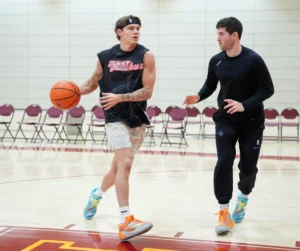
Who is Danny Cooper
Danny Cooper is a basketball trainer and academy owner based just outside Philadelphia. He got his start training players in high school, then expanded when he began interning for NBA skill trainer Drew Hanlon in 2021. That experience introduced him to the constraints-led approach to player development — a framework that would shape everything about how he works.
He met Mac McClung during that internship and the two have become close training partners. Mac has gone on to win the NBA Slam Dunk Contest twice and continues to develop his game with Danny in the summers. Danny also works with other professional players, including Lamar Stevens of Paris Basketball.
On the basketball training academy side, Danny trains youth and high school players in Bala Cynwyd — 80 to 100 athletes per month — with plans to expand to a second location within the next year.
The basketball training academy membership model that drives recurring revenue
Danny first learned the monthly membership model from Drew Hanlon at a seminar. The idea: instead of charging per session, players pay a recurring monthly fee to come one, two, or unlimited times per week.
When he was still in college, Danny ran that model in his backyard. He had around 45 kids paying $200 a month — all from six to eight hours of work per week.
“I was like, this is crazy,” he said. “So I think a lot of times, like when I first started in high school, I would start out with the individual training and the one-on-one.”
When he went full-time, he formalized the model. Today his academy offers three membership tiers — once, twice, or unlimited per week — across 16 hours of group workouts each week. That consistent monthly revenue is the foundation the whole business is built on.
He still does high-ticket private training for select clients, but the membership model is the engine. That consistency is what gives the whole business a foundation. See how other academy owners collect payments automatically without chasing cash or Venmos.
For more on why the group model works economically, see Group Training vs Individual Sessions: The Economics.
Why Danny’s basketball training academy runs zero drills with advanced players
At the professional level, Danny’s training looks nothing like what most people picture. With Mac McClung, there are no cone drills, no isolated skill repetitions, no scripted footwork sequences.
“When we work out, we never do any drills. It’s literally just putting him in a game situation and trying to challenge him,” Danny explained.
In practice, that means two-on-two paint work with ball screens to build passing reads, full-court pickup to work on conditioning and defense, and open-ended exploration sessions where Mac is encouraged to try moves Danny has never even seen before.
“We try to almost make the court as his canvas for him to experiment and try crazy stuff.”
That philosophy — grounded in the constraints-led approach — focuses on decision-making in realistic environments rather than perfecting movements in isolation. The idea is that players trained in live situations transfer their skills more reliably when games are on the line.
This isn’t a new idea. But Danny is one of the trainers actually doing it consistently, and with high-level players who validate the approach. For a deeper look at how coaches apply this in group settings, see Constraints-Led Approach Basketball Training: Jeff Schmidt.

How do you train 100 youth athletes differently from an NBA player?
The constraints-led approach doesn’t disappear with youth players — but the execution shifts. With kids, Danny is more direct. He’ll pull players aside mid-session for direct feedback and introduce named actions: horn sets, zoom actions, 45 cuts, burn cuts. Players earn a bonus point in 3×3 games for executing those concepts correctly.
“We want to improve and accelerate that learning curve. So I think being a little more hands-on and kind of not telling them what to do, but showing them some new options,” he said.
He’s also built a basketball IQ library inside CoachIQ — short video clips, concept definitions, and quizzes — that players can access at home between sessions. Homework for basketball players. Shoot 25 threes and track your makes. Watch three clips on 45-cut reads and complete a quiz.
“There’s been a couple of our kids that have really taken that seriously. And we see the results from the workouts.”
How Danny uses CoachIQ to manage 600 families without the admin chaos
At 80-100 athletes per month, communication becomes a full-time job if you let it. Danny doesn’t let it.
He built a list of roughly 600 families inside CoachIQ. He reaches all of them at once using mass announcements and automated reminders — no group texts, no phone calls. When a pop-up clinic goes on the calendar — held on school in-service days and holidays when kids are off — he sends one message to the entire list. The link, the registration form, and the payment are all in the same announcement.
“I’ll send out a mass announcement to my probably 600-person email list in Coach IQ,” Danny said. “I can put the link right there and they go right to it. Typically they’ll fill out a form and then they’ll purchase the product.”
Those pop-up clinics have become a meaningful off-season revenue tool. Thirty kids at $75 each in a single day — no Venmos, no checks, no awkward cash collection after the session.
“CoachIQ has made that a seamless product for us to where I don’t have to collect cash from parents or checks.”
The key takeaway
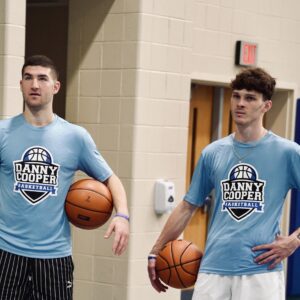
Danny Cooper didn’t wait until he had a facility, a staff, or a proven system. He started with a backyard half-court and a monthly membership model he borrowed from a seminar. His team got room to grow into their roles. Training Mac McClung for free before Mac was anybody — that’s the kind of relationship investment that eventually pays off.
That’s the pattern: consistent action, a model built for recurring revenue, and tools that handle the admin so you can stay on the court.
If you’re building a basketball training academy, the first move is getting your operations off text messages and spreadsheets. See how CoachIQ helps academy owners manage 100+ athletes without the chaos — and book a free demo to walk through what other coaches are doing right now.
Connect with Danny on his website and follow him on Instagram
