

Evidence-based basketball training is transforming how smart coaches develop players—and Freddy Webb’s journey shows why. You’ve watched a player drain 50 jumpers in warmups, then miss every shot when the game starts. Freddy lived that frustration, shooting 500 shots a day in college and still struggling to score in games.
Evidence-based basketball training means designing practice environments that mirror game demands—using constraints, variability, and self-organization instead of prescriptive technique drills. It’s the difference between players who perform in practice and players who perform when it matters.
Freddy is a professional player in Australia’s NBL1, a trainer who’s worked with NBA veterans including George Nang and Duncan Robinson, and the founder of Adapt Basketball. His journey from Darwin—a remote town of 120,000 people—to training elite athletes offers a masterclass in evidence-based player development.
In this episode
- Why the “make 1,000 shots” approach failed Freddy as a player—and what actually works
- How growing up with scientist parents shaped his training philosophy
- The constraints-led approach explained through real examples
- Building a training business through word of mouth and authentic content
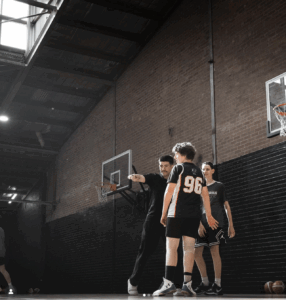
How a scientific background led to evidence-based basketball training
Freddy’s father is the world’s leading expert on saltwater crocodiles. Growing up at the family’s research center, Freddy absorbed something beyond work ethic: the scientific method. His dad taught him that good science means trying to disprove your hypothesis until you can’t.
This mindset eventually collided with traditional basketball training. In college, Freddy was first in the gym at 5 a.m., making 500 shots daily, outworking everyone.
And he still couldn’t shoot well in games.
“It can’t just be a reps thing because I’m shooting four times as much as everyone else here and I’m still not shooting well in the game.”
The hypothesis that more reps equals better performance kept getting disproved. This led Freddy to skill acquisition research and the constraints-led approach—an evidence-based basketball training methodology that matched what research shows about how humans actually learn movement skills.
Evidence-based basketball training: the constraints-led approach in practice
The shift wasn’t just intellectual. Freddy started experiencing breakthroughs immediately.
“Every training session, I was doing something I hadn’t done before. I hit a jumper and jumped like two feet in the air—I had never jumped like that because I didn’t think I could shoot the ball differently twice.”
The old belief: shoot the exact same way every time. The new understanding: you need to put the ball in the same place (the hoop), but how you get it there can—and should—vary.
This aligns with the constraints-led methodology Jeff Schmidt uses at Schmidt Performance—designing environments that force adaptation rather than prescribing solutions. Both coaches arrived at the same conclusion: the environment teaches better than verbal cues.
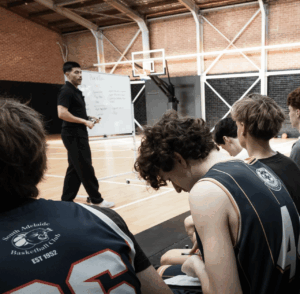
Teaching beginners with evidence-based basketball training
The most common pushback against evidence-based methods: “How do you teach fundamentals to beginners?”
Freddy starts with equipment. Lower the hoop. In Australia, kids play on full-size hoops at age 10. In Europe, they keep hoops lowered until 14. European kids develop more functional mechanics because they’re not compensating for strength limitations.
Beyond equipment, Freddy creates representative challenges rather than isolated drills.
“I might pass and give him a mini close-out. I’ll block it once or twice. After the second time I block it—without telling him anything—the kid starts to get lower. He opens up his hands. He’s figuring it out himself.”
Within three sessions, kids who couldn’t finish with their left hand in isolation are making contested reverse layups—because the environment required them to find that solution.
The key insight: kids are smarter than coaches give them credit for. When Freddy asks teenagers to create their own differential learning workouts, “some of the stuff they come up with is brilliant.” This creativity—and the joy that comes with ownership over development—gets lost when coaches over-prescribe technique.
Why traditional coaching fails the transfer test
Early in his career, Freddy ran the standard approach. Line up, make 10 left-hand layups in a row, then go play live.
“Do you think they even attempt a left-hand layup? No.”
The skill existed in isolation but didn’t transfer. This connects directly to why traditional session structure fails—the gap between practice and game performance comes from environments that don’t represent real demands.
The transfer problem isn’t a player issue. It’s a training design issue.
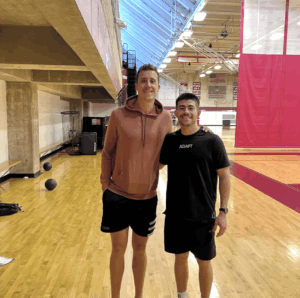
Evidence-based basketball training with NBA players
Freddy recently worked with George Nang and Duncan Robinson. Both are veterans with efficient shooting numbers. The biggest shift wasn’t the constraints approach—they already understood game-realistic training. It was differential learning.
“Both were taught to shoot the ball the same way each time. Now they’re getting older, people are closing out like crazy. The NBA is trying to run people off the line.”
The solution isn’t more reps of the same shot. It’s building ability to score from varied positions and release points.
“You don’t need to shoot the ball the same way. You just need to put the ball in the same place—the center of the hoop.”
What keeps elite players engaged? Challenge. They’ll make 10 out of 10 standard shots—that’s boring. Variability and novel constraints keep training engaging after thousands of workouts.
Building a training business from remote Australia
Darwin is twice the size of Texas with 250,000 people. The closest city with basketball infrastructure is a 3-hour flight away.
Freddy’s approach: word of mouth and consistent content.
“Parents tend to be very proud of their kid working out with someone they feel is doing a good job, and they’re quick to talk about it.”
This referral-first approach mirrors Russell Reeder’s blueprint for $100K+ coaching businesses—systems matter, but word of mouth remains the foundation.
For social media, Freddy sees it as necessary but not primary. Posting valuable content keeps him top of mind. But the foundation remains delivering results parents want to talk about.
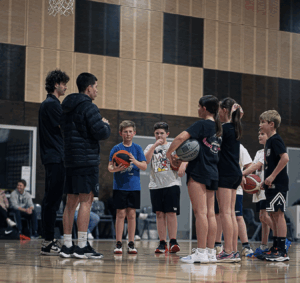
The systems that support evidence-based training
The irony of evidence-based basketball training: the real work happens before the session. Designing effective environments takes more thought than running preset drills.
That means admin needs to run itself. When scheduling, payments, and manual reminder texts eat into planning time, training quality suffers.
Tracking each player’s development requires centralized session notes and progress tracking to stay organized across dozens of athletes.
Tools like automated scheduling and payment processing free up 10+ hours per month—time you can spend designing environments that actually develop players.
Connect with Freddy
Find Freddy on Instagram at @adaptbasketball_ for training content and evidence-based approaches to player development.
Ready to focus on what matters?
Designing evidence-based training environments takes preparation time. CoachIQ gives you 10+ hours back per month—time you can spend planning sessions that actually transfer to games.
